Why You Can Trust God's Promises Even When Life Lets You Down

Why You Can Trust God's Promises Even When Life Lets You Down
Trust is something we extend every day, often without thinking. But when people, circumstances, or life itself breaks that trust, it can quietly shape how we see God. The good news is that God is not like people. He cannot lie, He never changes, and every promise He makes, He keeps.
What Does It Mean to Grow in Faith?
Hebrews 6 opens with a challenge to move past the basics of faith and press into maturity. The writer of Hebrews calls believers to stop wading in the shallow end and go deeper into what God wants us to know. Part of that growth means learning from those who have gone before us, people who walked through difficulty with faith and patience and still received what God promised.
Hebrews 6:12 sets the stage: "So that you may not be sluggish, but imitators of those who through faith and patience inherit the promises."
The example that follows is Abraham, and what his story teaches us is still deeply relevant today.
The Promise God Made to Abraham
When God made a promise to Abraham, He had no one greater to appeal to. No court. No higher authority. So He swore by Himself.
"For when God made a promise to Abraham, since he had no one greater by whom to swear, He swore by Himself, saying, 'Surely I will bless you and multiply you.'" - Hebrews 6:13-14
This promise points back to Genesis 22, when God asked Abraham to do the unthinkable: sacrifice His only son, Isaac. Abraham obeyed. He carried the wood up the mountain, built the altar, and was prepared to follow through. At the last moment, God stopped Him and provided a ram instead.
It was a test of obedience. And Abraham passed.
God then declared in Genesis 22:16-18: "By myself I have sworn, declares the Lord, because you have done this and have not withheld your son, your only son... I will surely bless you and multiply your offspring as the stars of heaven and as the sand that is on the seashore."
Delays Do Not Cancel God's Promises
Abraham waited. He endured. And he received what God had promised. But it did not happen on his timeline or in the way he might have imagined.
This is one of the most important things to hold onto: delays never cancel God's promises.
When life feels uncertain, when prayers seem unanswered, when the wait stretches longer than expected, God's word remains true. His promises do not expire. They do not weaken with time. Abraham's story is proof of that.
Why Did God Confirm His Promise with an Oath?
God did not swear an oath because His promise was weak. He did it to strengthen the confidence of His people.
"So when God desired to show more convincingly to the heirs of the promise the unchangeable character of His purpose, He guaranteed it with an oath." - Hebrews 6:17
Two things about God are unchangeable: His promise and His oath. He cannot lie. He does not shift. He is the same yesterday, today, and forever. That is the foundation our hope rests on.
The original audience of Hebrews were Jewish believers who had come to faith in Jesus and were being tempted to turn back to old religious rituals. The writer's message to them was clear: there is nothing better to return to. Jesus is better. And the assurance of that truth rests entirely on God's character, not on human effort or ability.
How the Enemy Uses Doubt to Pull Us Away from God
One of the enemy's oldest strategies is to make us doubt God's promises. When we go through a rough patch, when we sin, when life gets hard, the temptation is to believe that God does not really love us the way we have been told He does.
And when that doubt takes root, we do what Adam and Eve did in the garden. We try to cover ourselves and hide from God.
But that is exactly backwards. The anchor God has provided is not a reason to run. It is a reason to return. His love does not depend on our performance. Our assurance is not based on our ability to hold on. It is based on His inability to fail.
What Is the Anchor of the Soul?
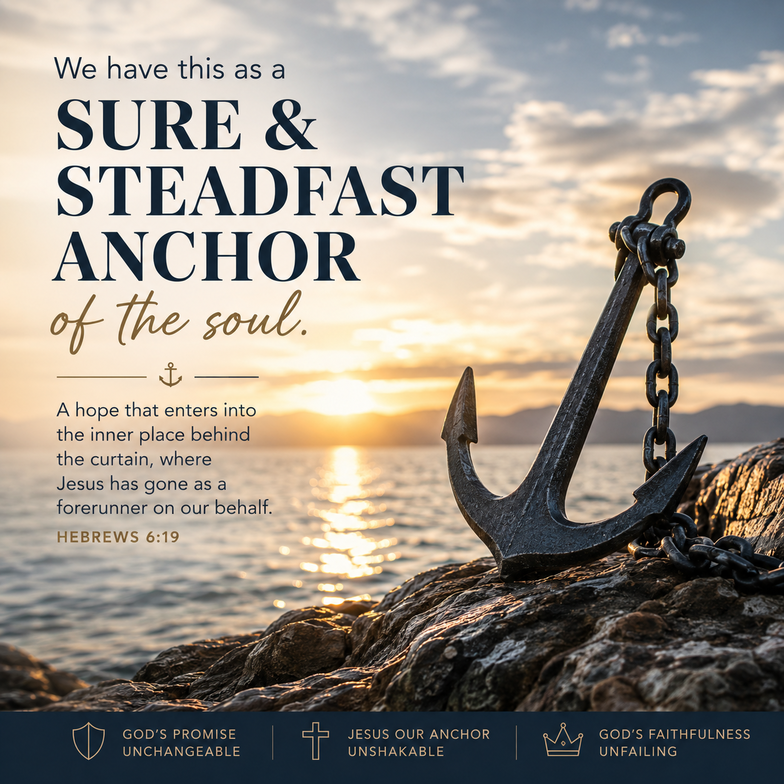
"We have this as a sure and steadfast anchor of the soul, a hope that enters into the inner place behind the curtain, where Jesus has gone as a forerunner on our behalf." - Hebrews 6:19
This anchor is unlike any earthly anchor. A physical anchor pulls things down. But this anchor lifts us up. It is not attached to the things of this world. It is attached to Jesus Himself, who sits at the right hand of the Father in the most holy place.
When Jesus died, the veil in the temple was torn in two. That curtain had separated ordinary people from the most holy place, a space only the high priest could enter once a year. Jesus tore it open and gave every believer direct, eternal access to the throne of God.
That is where our anchor holds. Not in this world, not in our circumstances, not in our own strength. Our souls are anchored in Jesus, our High Priest, who makes intercession for us.
What Biblical Hope Actually Means
Biblical hope is not wishful thinking. It is confident expectation based on who God is.
- Our hope rests on God's promise.
- Our hope rests on God's oath.
- Our hope rests on God's Son.
God keeps every promise. He cannot lie. He never changes. That is the anchor. That is the foundation. And it is more than enough.
Life Application
This week, take time to remember a specific promise from God's Word that applies to something you are walking through right now. Write it down. Pray over it. Let it be the anchor you return to when doubt creeps in.
Instead of hiding from God when life gets hard or when you fall short, run toward Him. The anchor is not attached to your performance. It is attached to His faithfulness.
Ask yourself these questions as you reflect this week:
- Is there an area of my life where I have been doubting God's promises instead of trusting them?
- When things get hard, do I tend to run toward God or away from Him, and why?
- What would it look like this week to anchor my hope in who God is rather than in my circumstances or my own ability?
The anchor holds because Jesus holds. That truth is worth returning to every single day.