They're Watching

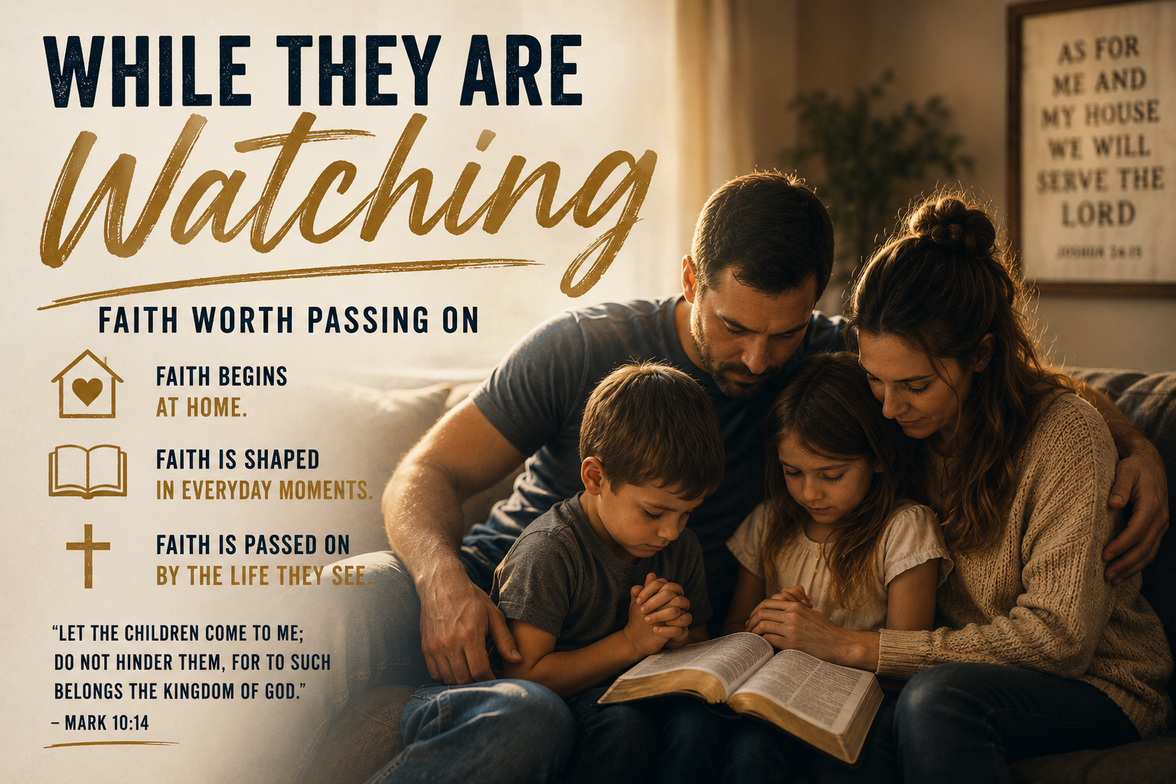
Before your children can read the Bible, understand a sermon, or explain what faith means, they are watching you. The most powerful spiritual influence in a child's life is not a church program or a Sunday school class. It is the everyday faith they witness at home.
What Does It Mean to Dedicate a Child to God?
A baby dedication is not about saving a child's soul. Salvation is a personal decision that every individual must make for themselves one day. A dedication is about the adults making promises. It is about parents saying to God, "You have entrusted this life to us, and with Your help, we intend to raise this child to know You."
It is also a reminder that parents are not alone. Grandparents, family, friends, and the church are all part of building a spiritual legacy for a child.
What Does the Bible Say About Raising Children?
Scripture is clear and consistent on this topic. Three passages paint a full picture of what God expects from those who raise children.
- Deuteronomy 6:4-7 instructs parents to love God first, then teach that love to their children in the ordinary moments of every day.
- Psalm 127:3-5 reminds us that children are a heritage from the Lord, a reward, and a blessing entrusted to our care.
- Ephesians 6:4 calls fathers specifically to bring children up in the discipline and instruction of the Lord.
"Behold, children are a heritage from the Lord, the fruit of the womb a reward. Like arrows in the hand of a warrior are the children of one's youth." - Psalm 127:3-4
Why the Order in Deuteronomy 6 Matters
Notice the order God gives in Deuteronomy 6. He does not start by telling parents to teach their children. He starts by telling parents to love Him first.
"You shall love the Lord your God with all your heart and with all your soul and with all your might. And these words that I command you today shall be on your heart. You shall teach them diligently to your children." - Deuteronomy 6:5-7
You cannot give your children something you do not have. If you want your child to love God, they need to see what loving God looks like in you. That is where it starts.
Your Children Are Watching More Than They Are Listening
Children are sponges. They imitate everything. They repeat what they hear. They walk the way you walk. They respond to life the way they have seen you respond to life.
So the real question is not just what are we telling our children about Jesus. The question is what are they seeing?
- We tell them prayer matters. But do they see us pray?
- We tell them the Bible is God's Word. But do they see us open it?
- We tell them church is important. But does our calendar agree?
- We tell them to forgive. But how do we handle conflict in front of them?
- We tell them to be kind. But do they hear us talk about others when they are not around?
Every one of these moments is shaping how your child understands faith, God, and what it means to follow Jesus.
Are You Childproofing Your Home Spiritually?
Most parents childproof their homes physically. They put locks on cabinets, secure dangerous chemicals, and add barriers near pools. All of that is done to protect a child who does not yet know the danger on the other side.
But are we doing the same thing spiritually?
What voices are shaping your children? What are they watching, listening to, and absorbing through screens and devices? You would never allow a stranger to walk through your front door and into your teenager's room unsupervised. But handing over a device with no safeguards in place does exactly that. It opens a direct line to your child's eyes and ears with no filter.
Spirit-proofing your home means being intentional about what influences are allowed in and what spiritual safeguards are in place.
Faith Happens in Ordinary Moments, Not Just on Sundays
Deuteronomy 6:7 says to teach your children when you sit in your house, when you walk by the way, when you lie down, and when you rise. That covers all of life. Not just Sunday morning.
Faith becomes real to children when they see it woven into the ordinary rhythm of daily life. At the dinner table. On the way to school. At bedtime. During hard seasons. In the middle of celebrations. Jesus cannot simply be someone the family visits for an hour on Sunday.
If He is carved out only for Sunday and the rest of the week looks no different, children notice. And they will mirror it.
You Do Not Have to Be a Perfect Parent
Nobody parents perfectly. And that is not the goal. Sometimes the most powerful example you can set for your child is what happens after you get it wrong.
When you look your child in the eye and say, "I was wrong. Will you forgive me?" you are showing them what repentance looks like. You are showing them what grace looks like. You are showing them that faith is not about being perfect. It is about turning back to God and to one another.
Let them see what seeking God in Scripture looks like. Let them see what worship and trust look like in real life. Give them a faith worth watching.
The Church Supports, But Cannot Replace the Home
Sunday school teachers, youth leaders, children's ministry workers, and pastors all play a meaningful role. But none of them can replace what happens at home.
When what a child hears at church is different from what they experience at home, faith becomes a conflict. It becomes an option rather than a priority. The church is here to help reinforce what is being built at home, not to carry the full weight of discipleship on its own.
We cannot outsource the spiritual formation of our children.
The Ultimate Goal Is Not Raising a Successful Child
Every parent wants good things for their children. Health, safety, education, good friendships, success. Those are not bad desires. But the greatest thing we can want for our children is that they know Jesus.
A child can be educated, talented, financially secure, and successful by every worldly measure. But without Jesus, none of it is enough. The ultimate prayer is not "Lord, help me raise a good kid." It is "Lord, help me raise this child so they see You."
Only Jesus saves. Not grandparents, not pastors, not the church, not the school. One day every child will have to personally respond to the gospel. Until then, we teach, we pray, we model, and we point them to Christ.
"Let the children come to me; do not hinder them, for to such belongs the kingdom of God." - Mark 10:14
Life Application
This week, take one honest look at what your children are actually seeing when they watch you. Not what you are telling them, but what they are observing in your daily life.
Choose one specific and practical way to make Jesus more visible in your home this week. It might be praying together at dinner, opening the Bible before bed, or simply apologizing to your child when you get something wrong and letting them see what grace looks like in action.
Ask yourself these questions:
- If my children learned everything they know about Jesus by watching me this past week, what would they have learned?
- Is Jesus visible in the ordinary moments of my home, or only on Sunday mornings?
- What is one area where what I say about faith and what I model at home do not yet line up?
- Am I praying consistently for the day my child personally responds to the gospel?
Children are a gift from God, entrusted to our care for a season. Like arrows, they are meant to be prepared and released. The question is what direction we are pointing them. Point them to Jesus, not just with your words, but with your life.