Jesus Is the Substance, Not the Shadow

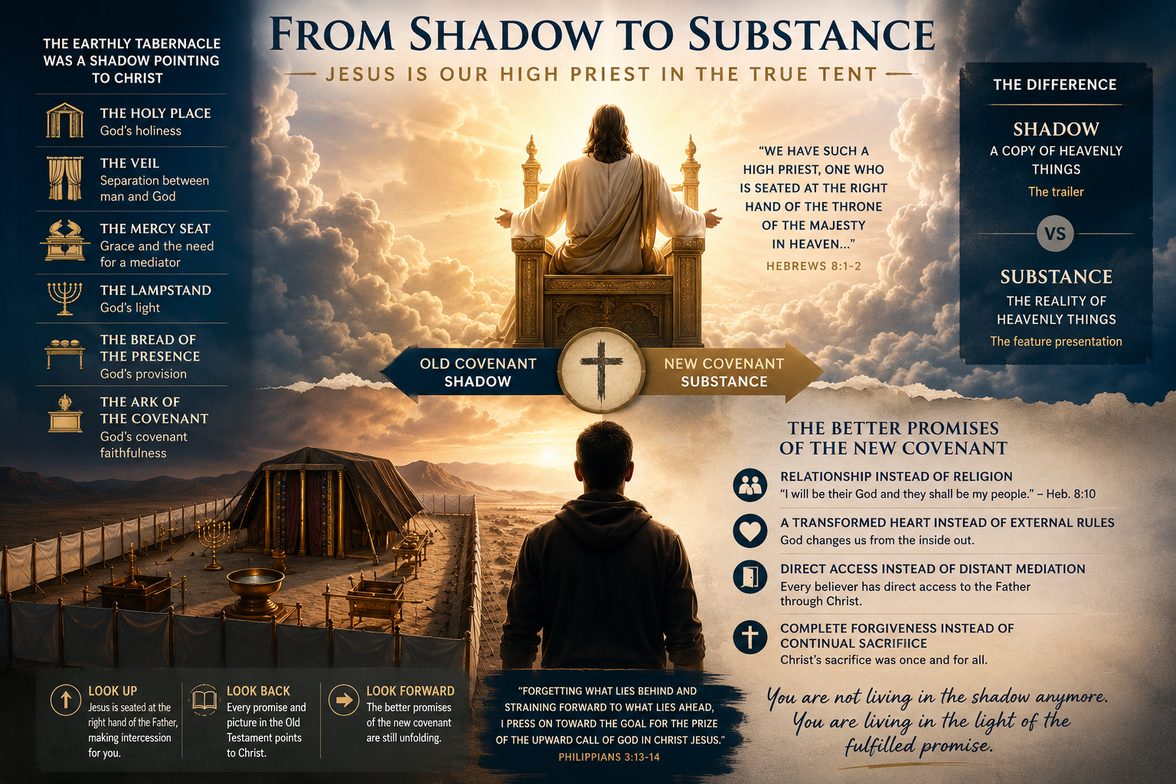
God has always been a teacher who uses pictures before presenting the full reality. Before Jesus came, God gave Israel an earthly picture of heavenly things. The tabernacle, the priesthood, the sacrifices — none of it was the final destination. It was always pointing forward to something greater.
What Does It Mean That Jesus Is Our High Priest?
Hebrews chapter 8 opens with a bold declaration. After everything the writer has been building toward, he essentially says, "I said all that to say this." The point is this: we have a high priest who is seated at the right hand of the throne of the Majesty in heaven.
"Now the point in what we are saying is this: we have such a high priest, one who is seated at the right hand of the throne of the Majesty in heaven, a minister in the holy places, in the true tent that the Lord set up, not man." - Hebrews 8:1-2
Jesus is no longer ministering in an earthly sanctuary. He has ascended, and He is seated in glory, serving as our high priest in the true, genuine, original heavenly sanctuary.
What Is the "True Tent" in Hebrews 8?
When Hebrews refers to the "true tent," it does not mean the earthly tabernacle was fake or invalid. The word "true" here means original, authentic, and genuine. The earthly tabernacle was real. But it was a pattern, a model, a shadow of the heavenly reality that God always intended.
God gave Moses very specific instructions for how to build the tabernacle. Every detail had a purpose. Every element pointed beyond itself toward Christ.
What Did the Tabernacle Represent?
The tabernacle was not just a building. It was theology you could walk through. Consider what each element revealed about God:
- The Holy Place represented God's holiness and the high standard required to approach Him.
- The Veil showed the separation between sinful man and a holy God.
- The Mercy Seat pointed to grace and the need for a mediator.
- The Lampstand illustrated God's light.
- The Bread of the Presence showed God's provision.
- The Ark of the Covenant declared God's covenant faithfulness.
Every single piece anticipated Christ. When Moses stood on Sinai, he was not inventing worship. He was receiving a glimpse of heavenly realities expressed in earthly form.
What Is the Difference Between a Shadow and the Substance?
Hebrews 8:5 says the priests "serve a copy and shadow of the heavenly things." Those are not throwaway words.
Think about what a shadow actually is. If you stand in front of a light, your body blocks that light and casts a shadow. The shadow has the form of you, but it is not you. No one embraces a shadow. You embrace the person who cast it.
The Old Testament sacrifices, the priesthood, the tabernacle — these were the shadow. Christ is the substance. The shadow found its fulfillment, and that fulfillment is Jesus.
Think of it like a movie trailer. A good trailer introduces the characters, hints at the conflict, and builds anticipation. But no one walks out of the theater after watching a trailer and says they have seen the movie. The Old Testament was the trailer. Christ is the feature presentation.
Why Is Jesus Called a Better High Priest?
Throughout the book of Hebrews, the writer builds a consistent case. Jesus is better than the angels. Better than Moses. Better than Abraham. Better than the Levitical priesthood. And now in chapter 8, we see that He brings a better ministry, a better covenant, and better promises.
"But as it is, Christ has obtained a ministry that is much more excellent than the old, as the covenant He mediates is better, since it is enacted on better promises." - Hebrews 8:6
The old covenant was based on Old Testament promises. The new covenant is enacted on better promises. Jesus is not an improvement on the old system. He is the fulfillment of everything the old system was pointing toward.
What Are the Better Promises of the New Covenant?
Hebrews 8:6 announces these better promises without fully explaining them yet. But here is a preview of where the text is headed:
- Relationship instead of religion. "I will be their God and they shall be my people." (Hebrews 8:10) This is not about going through motions to qualify for righteousness. It is about a genuine relationship with God through Christ.
- A transformed heart instead of external rules. We cannot live the Christian life in our own power. God promises to change us from the inside out, not just give us a list of rules to follow.
- Direct access instead of distant mediation. We do not need a special intermediary to reach God. Every believer has the same direct line of communication to the Father through Christ.
- Complete forgiveness instead of continual sacrifice. The old system required repeated offerings. Christ's sacrifice was once and for all.
These are not upgrades to the old covenant. They are an entirely new covenant, secured by Jesus alone.
What Does It Mean to Stop Living in the Shadows?
As believers, there is a challenge to stop living as though Christ still needs to do something. He has already gone to the cross. He has already risen from the dead. He has already ascended to the throne. He is already making intercession for us right now.
"I am with you always, even to the end of the age." - Matthew 28:20
He is with us in the storms. Sometimes God allows difficulty to press us further into faith. Just as muscles only develop when pushed past their current limit, faith only grows when it is stretched. The storms of life are not signs that God has abandoned us. They are often the very thing He uses to anchor us more deeply to Him.
Peter walked on water until he took his eyes off Jesus and began to sink. When he cried out, Jesus reached down and lifted Him. That is still the promise today. We can walk through the storms, and when we feel like we cannot make it, we can cry out and He will be there.
How Should We Respond to This Truth?
There are three directions worth considering. Look up and remember where Jesus is right now, seated at the right hand of the Father, making intercession for you. Look back and see how every promise, every picture in the Old Testament moved toward Christ. And look forward, because the better promises of the new covenant are still unfolding.
"Forgetting what lies behind and straining forward to what lies ahead, I press on toward the goal for the prize of the upward call of God in Christ Jesus." - Philippians 3:13-14
The best is still happening. The new covenant is not a shadow of something coming. It is the real thing, and it is yours through faith in Christ.
Life Application
This week, take time to intentionally shift your gaze. If you have been living as though your faith depends on your own effort, your own rule-keeping, or your own ability to hold it together, stop and remember what the new covenant actually promises. You have direct access to God. You have a high priest who is interceding for you right now. You are not living in the shadow anymore. You are living in the light of the fulfilled promise.
Your challenge this week: Identify one area of your life where you have been striving in your own strength rather than trusting in the better promises of the new covenant. Bring it to God in prayer, and ask Him to help you walk in the reality of what Christ has already secured for you.
Ask yourself these questions:
- Am I living in relationship with God, or am I just going through religious motions?
- When storms come into my life, what am I anchored to?
- Do I truly believe that Jesus is making intercession for me right now, and how does that change the way I pray?
- Is there an area of my life where I am still living as though Christ has not already finished the work?